

Published date : 26 October 2026
Lula’s re-election opens a new political phase but does not, at present, mark a change in the government’s position on sports betting and online games. For Game Interaction, the sector’s future must be based on strict rules, player protection and investment certainty.
The confirmation of Luiz Inácio Lula da Silva as President of Brazil, following the second round on 25 October, brings the future of the betting market back into focus. For operators, technology providers and businesses involved in the supply chain, the question is concrete: now that the election campaign has ended, do the conditions exist to reconsider the ban?
As of the publication date, neither a reopening of the market nor an official reconsideration by the president has been announced. The latest explicit statement identified dates back to 22 October, when Lula reiterated his opposition to the return of the platforms, citing the consequences of indebtedness and problem gambling on families.
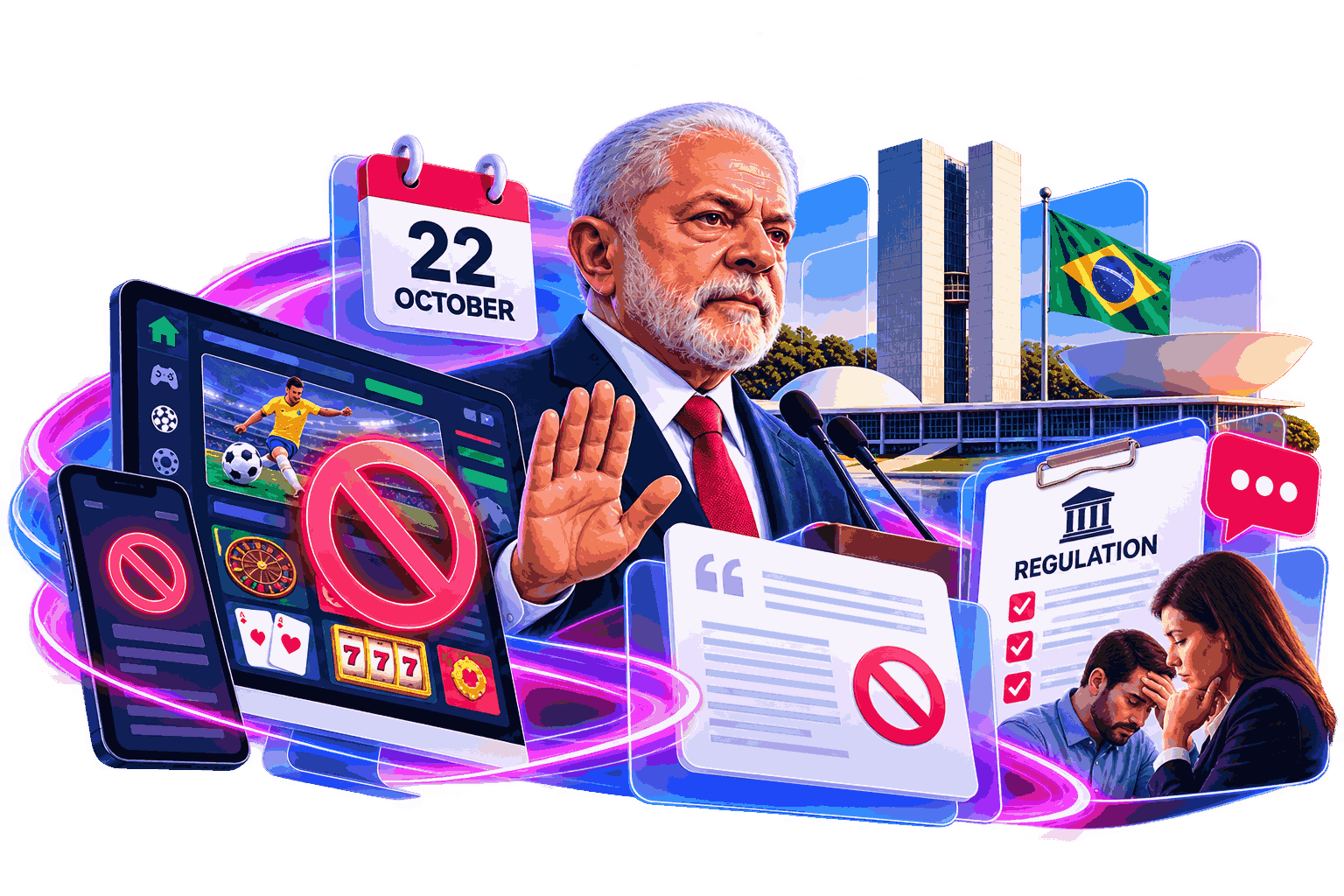
Medida Provisória No. 1,394 of 25 September 2026 prohibited the operation, offering, intermediation and advertising of fixed-odds betting, including sports betting and online games. The measure also covers offerings directed at people located in Brazil by operators based abroad; other lottery modalities authorised by law remain excluded from this specific ban.

Following the election result, new calls emerged to reopen the discussion. In the editorial published on 25 October by BNLData, Magno José invited the president to reconsider the ban and engage with the regulated sector. This is a call for change, not confirmation of an opening by the government.
The discussion also continues within the institutions. The measure remains under consideration by Congress, and legal challenges are pending. Any parliamentary amendment or judicial suspension would have effects distinct from a reconsideration by the president: these paths must be followed separately, without anticipating their outcome.
We believe these objectives require a system capable of identifying operators, verifying products, monitoring financial flows and making responsible gambling measures enforceable in practice. Our position is that strict regulation offers more effective tools for pursuing these aims and combating illegal offerings.

The main risk we want to highlight is that eliminating the legal offering may not eliminate demand for gambling, but instead shift it towards offshore operators not authorised to target the Brazilian market: the so-called “.com” sites. This reference does not concern the domain extension itself, but platforms that accept players outside the national authorisation and oversight system. Deprived of the regulated alternative, users could turn to these channels, with fewer guarantees regarding the protection of funds, the handling of complaints and the effective application of responsible gambling measures.

Game Interaction will continue to follow developments in Brazil closely, distinguishing future opportunities from the conditions actually in force. We believe in the potential of a transparent and responsible market and hope for a discussion based on data, expertise and shared objectives.